If your revenue runs through Stripe subscriptions, most of next quarter is already written down. Every active subscription carries an amount, a billing interval, and the date it renews next. Line those up and you can see, to the day, which money should arrive when. Yet most SaaS companies still plan cash in a spreadsheet with one column per month and a guess in every cell, which throws away the one forecasting advantage a subscription business has.
What a monthly forecast hides
A monthly cash plan answers one question: does more come in than goes out this month? Useful, but it averages away timing, and timing is where cash problems live. Say you start July with €50,000, expect €55,000 in collections, and have €75,000 of spend planned. The spreadsheet says you end the month at €30,000. Comfortable. What it does not say: €30,000 of that inflow is a single annual renewal due on the 22nd, and €55,000 of the spend is payroll leaving on the 28th. If that one invoice slips by two weeks, because the card failed or the customer pays by bank transfer at their own pace, the month still ends fine on paper while your account runs dry on payroll day.
Cash runs out on a specific day, not in a specific month. Payroll day, the VAT deadline, the day a big vendor contract bills. A forecast that cannot see days cannot see the problem coming.
Your Stripe account already knows
For a subscription business, the inflow side is unusually knowable. Every active subscription in Stripe has a renewal date and an amount. Trials carry the date they convert. Cancellations are often scheduled weeks before they take effect. That is the raw material of a daily forecast, and it is sitting in your billing system right now.
MRR is the right lens for growth, but it is deliberately blind to timing: a €12,000 annual contract and twelve €1,000 monthly plans are the same MRR with completely different cash patterns. For cash you need the invoice-level view instead. Forty renewals on the 3rd. A dozen spread across mid-month. Two annual contracts that both happen to land in October.
From invoice date to money in the bank
A renewal that bills today is not cash today. Two delays sit in between, and a Stripe cash flow forecast should model both.
The first is collection. Most card payments clear right away, but some fail and spend days in retries before they recover (or become churn). Annual invoices are often paid by bank transfer on the customer's schedule, days or weeks after the invoice date.
The second is the payout schedule, the classic "when does Stripe pay out" question. Stripe collects your charges into a balance and pays that out on a schedule you choose: daily, weekly, monthly, or manually. How fast funds settle depends on your country. In the US it is two business days after the charge; in Germany and the UK about three business days once your account has some history, with new accounts starting at seven calendar days. A brand-new account waits 7 to 14 days for its very first payout. And payouts arrive net of Stripe's fees, so forecast what reaches the bank, not the sticker price of the invoice.
None of this makes forecasting harder in principle. It means shifting each expected invoice by your collection pattern and payout delay, which is exactly the kind of dull, mechanical adjustment software is better at than people are.
Doing it by hand
You can build this in a spreadsheet, and if cash is tight you should not wait for tooling (we made a free 13-week cash flow forecast template for exactly that). Export your active subscriptions from Stripe with the amount and next billing date. Lay them on a calendar, one row per day, shifted by your payout delay. Add the outflows you already know: salaries, rent, taxes, the annual software renewals that always surprise you. Then roll the balance forward one day at a time. Wherever the line dips is where your attention belongs.
The catch is decay. The export is stale the moment a customer upgrades, cancels, or a new deal closes. In practice a manual day-by-day forecast is a weekly rebuild, and it stops being rebuilt the first busy week. That is how most SaaS cash flow projections drift back to the monthly spreadsheet.
Letting the forecast build itself
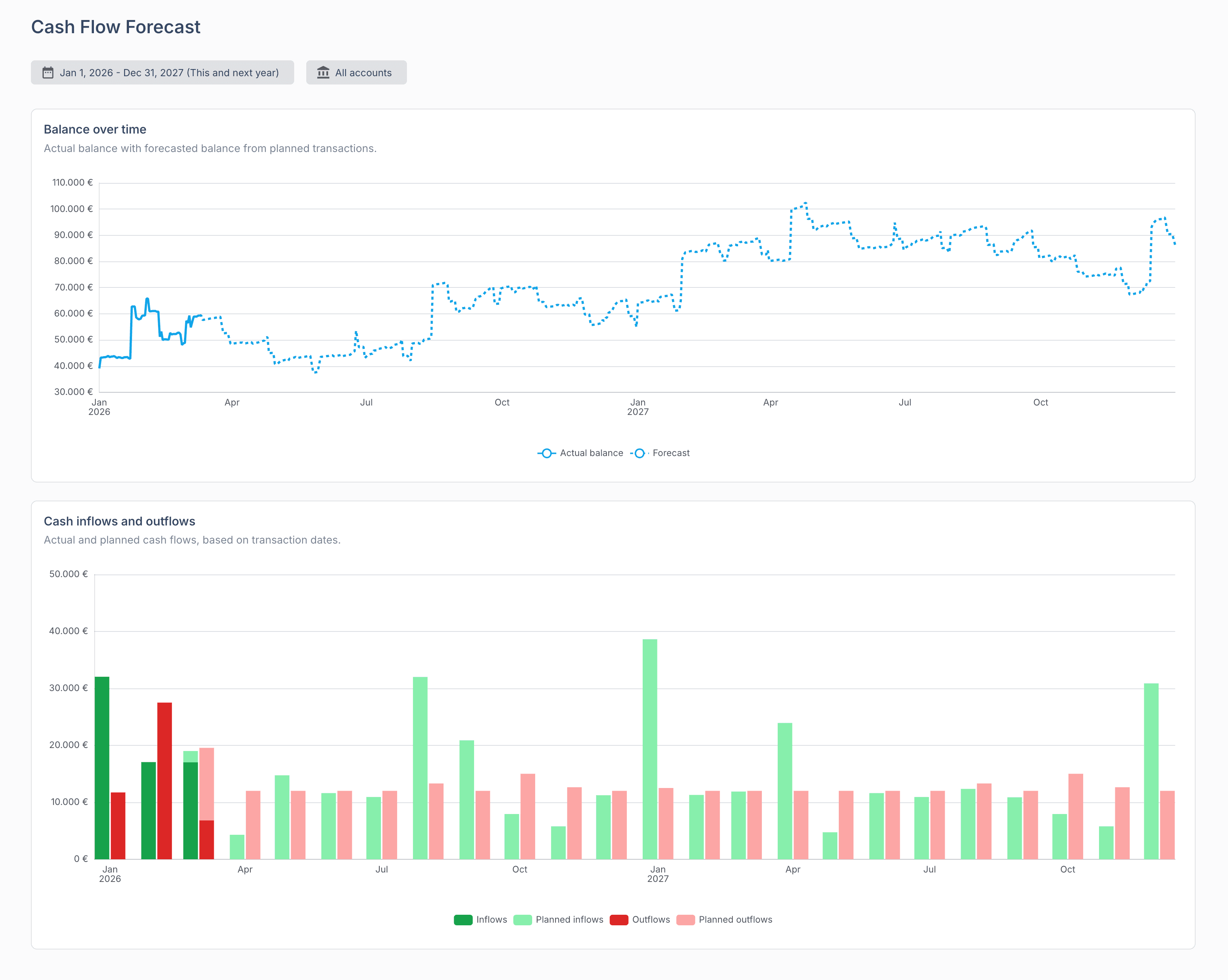
This is the part we built SaaSFlow for. Connect Stripe and every active subscription is projected forward automatically: each upcoming renewal shows up in the forecast on the day it bills. Add planned transactions for the outflow side, one-off or recurring: salaries, rent, tools, the hire starting in Q3. The result is a cash flow forecast at daily resolution, a projected balance line that starts from your live bank balance. Click into any dip and see exactly which renewals and which bills produced it.
Because the forecast is derived from live data, it stays current without the weekly rebuild. A customer cancels and the renewal disappears from the projection. A new deal closes and its billing schedule is part of the picture the same day. It also reconciles with the same numbers your subscription analytics and real-time P&L are built on; we wrote about reading those together in how to read your SaaS P&L and cash flow. Companies under €10,000 MRR use SaaSFlow free, no credit card.